Charge controllers – common functions, specific interfaces
Bender charge controllers – uniform functionality, flexible integration
Cross-device functions
Bender charge controllers enable the construction of durable and reliable charging stations.
They offer comprehensive, uniform functionality across all models: all variants support the same protocols, standards and functions.
Uniform firmware updates ensure that new features are available for all models.
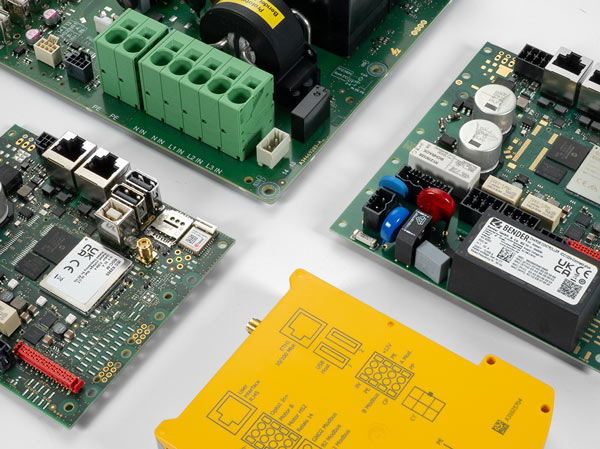
The differences lie in the integration: for classic AC charging stations, the controllers are designed for top-hat rail mounting. For compact or highly integrated wallboxes, Bender offers circuit board-based solutions.
Flexible interface selection – without interfering with the design
Communication interfaces such as 4G, Wi-Fi or Ethernet can be selected in a cost-optimised manner from the available variants of a charge controller – without any changes to the mechanical design of the charging station.
This makes it easier for manufacturers to integrate suitable charge controllers, regardless of the subsequent application scenario.
The following overview shows the key functions for AC charging that are included in all Bender charge controllers.
Further details can be found in the Charge Controller Software Documentation.
Bender charge controllers – uniform functionality, flexible integration
Cross-device functions
Bender charge controllers enable the construction of durable and reliable charging stations.
They offer comprehensive, uniform functionality across all models: all variants support the same protocols, standards and functions.
Uniform firmware updates ensure that new features are available for all models.
The differences lie in the integration: for classic AC charging stations, the controllers are designed for top-hat rail mounting. For compact or highly integrated wallboxes, Bender offers circuit board-based solutions.
Flexible interface selection – without interfering with the design
Communication interfaces such as 4G, Wi-Fi or Ethernet can be selected in a cost-optimised manner from the available variants of a charge controller – without any changes to the mechanical design of the charging station.
This makes it easier for manufacturers to integrate suitable charge controllers, regardless of the subsequent application scenario.
The following overview shows the key functions for AC charging that are included in all Bender charge controllers.
Further details can be found in the Charge Controller Software Documentation.
Features
Overview – Cross-device functions
Safety & protection functions
Maximum safety for users, operation and infrastructure
- Fault current monitoring (DC) via integrated RDC-M
- Earthing and insulation testing for safe installation
- Weld check for detecting switching faults
- Temperature monitoring for thermal protection
- Emergency opener in the event of a power failure
- Phase, voltage and frequency monitoring (via power module/IPM)
Standards & Protocols
Examples of relevant standards and communication protocols required for AC charging
- Compatibility with all common CSM systems
- ISO 15118: EN ISO 15118-2/-20 (AFIR-compatible)
- OCPP 1.6 & update to 2.x for standardised backend connection
- Modbus (RTU&TCP/IP) for energy management and meter integration
- §14a EnWG compliant – PLC and MLC use cases (via EEBus / PPC certified)
- SMA-Semp support for PV integration
- Weights and measures law for legally compliant operation and billing
- TOR (OVE guideline R37) & UK Smart Charging Regulation
Energy management
Intelligent features for efficient charging
- Mode 3 – Single-phase to three-phase charging with 230 V to 400 V (1.6 kW to 22 kW)
- Dynamic load management (DLM) including solar DLM for PV-optimised charging and complex load management with up to 250 charging stations
- Manufacturer-independent HEMS integration (via Modbus/TCP, EEBus, or SMA-Semp)
- Support for energy meters from over 30 manufacturers
Authorisation and payment
Flexible use in all charging scenarios, including automatic vehicle recognition and charging authorisation
- Plug & Charge* (including Hubject certification) for convenient AC charging
- RFID reader – authorisation via backend or whitelist
- Freecharge – various modes available
- Authorisation via app – iOS/Android version available
- Autocharge* – via PLC/ISO 15118 handshake (MAC-based authentication)
* if supported by the vehicle
Selectable communication interfaces
Depending on the variant, this allows flexible adaptation to different charging scenarios
- 4G/LTE – for mobile data communication
- Ethernet – dual version also supports daisy chain
- WLAN/Wi-Fi – wireless connection for easy installation
- USB – service/configuration interface and for accessories
- Modbus – for energy management and control
- Power Line Communication (PLC) – EN ISO 15118 communication with vehicles and smart grid
Charge controllers – common functions, specific interfaces Variant(s)
Communication: Overview of available interfaces for each model variant
| Product | Variant | Interfaces | |||||||
|---|---|---|---|---|---|---|---|---|---|
| LTE/4G | WLAN/Wi-Fi | Ethernet | USB Type-A | Modbus | Input | Output 12V | Output 230V | ||
| ICC1314 | Connect-Plus (G1) | ✓ | ✓ | 2 | 2 | 1 | 2 | 2 | 1 |
| Connect-Plus | ✓ | ✓ | 2 | 2 | 1 | 2 | 2 | 1 | |
| Companion (G1) | 1 | 1 | 2 | 2 | 1 | ||||
| ICC1324 | Connect-Plus | ✓ | ✓ | 2 | 2 | 1 | 2 | 2 | 1 |
| Connect-SP | ✓ | 2 | 2 | 1 | 2 | 2 | 1 | ||
| Home Plus | 2 | 2 | 1 | 1 | 1 | 1 | |||
| Home | 2 | 1 | 1 | 1 | 1 | 1 | |||
| CC613 | ELMP4PR-M | ✓ | ** | 1 | 1 | 2 | 1 | 1 | 1 |
| ELPR-M | ** | 1 | 1 | 2 | 1 | 1 | 1 | ||
| ELMP4PR | ✓ | ** | 1 | 1 | 1 | 1 | 1 | 1 | |
| ELPR | ** | 1 | 1 | 1 | 1 | 1 | 1 | ||
* Start of Charging
** via HMI150