It is not common for technology to be installed in churches to monitor the power supply. A project using technology from Bender was implemented in St. Peter's Cathedral in Osnabrück and it is truly impressive. This is a prime example of what is required today for a modern power supply that must be reliable and safe.
The Roman Catholic Cathedral of St. Peter in Osnabrück is the oldest church in the Diocese of Osnabrück. In addition to church events such as services and weddings, concerts and guided tours also take place in the building. Every year, around 30,000 people visit the cathedral, whose architectural roots date back to the 8th century and which today consists mainly of elements that were built in the 12th century.
The lighting system (interior lighting) in this church needed to be replaced because the old one was no longer working satisfactorily. Components were defective and the lighting still consisted of halogen lamps, which consume a lot of energy compared to today's lighting solutions.

An electrical engineering firm was commissioned to plan the new system. It quickly became apparent that the old control cabinets were in need of overhaul. The technology was outdated and partly defective. It was therefore decided to completely replace the control cabinets.
As events are often held in Osnabrück Cathedral in the evenings, emergency lighting also had to be incorporated into the overall concept.
For safety reasons, permanent monitoring including intelligent alarm management should also be installed.
Finally, the actual lighting was to be converted from inefficient halogen lights to modern LED technology.
The contract for the conversion was awarded to the renowned electrical company AGW Elektrotechnik from the region.
There were two main things that needed to be taken into account during the renovation:
As the building is a listed monument, the existing electrical installation network had to be largely preserved. Complete rewiring was not possible, so new cables could only be laid in some areas.
As many church events take place in the cathedral, a suitable time slot had to be found for the renovation work. There should be no restrictions on important church festivals.
Due to the nature of the project and the particular challenges involved, renovation work began immediately after Epiphany (6 January 2025).
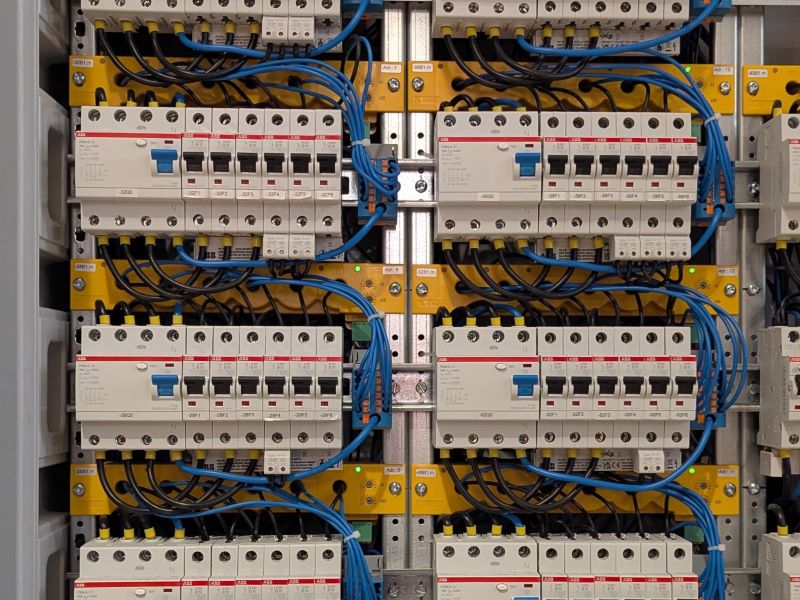
The entire electrical system was initially equipped with an ATICS® changeover device. In the event of a power failure, this enables a quick changeover from the normal power supply to a battery-backed (backup or emergency) power supply, thereby ensuring emergency lighting in the cathedral.
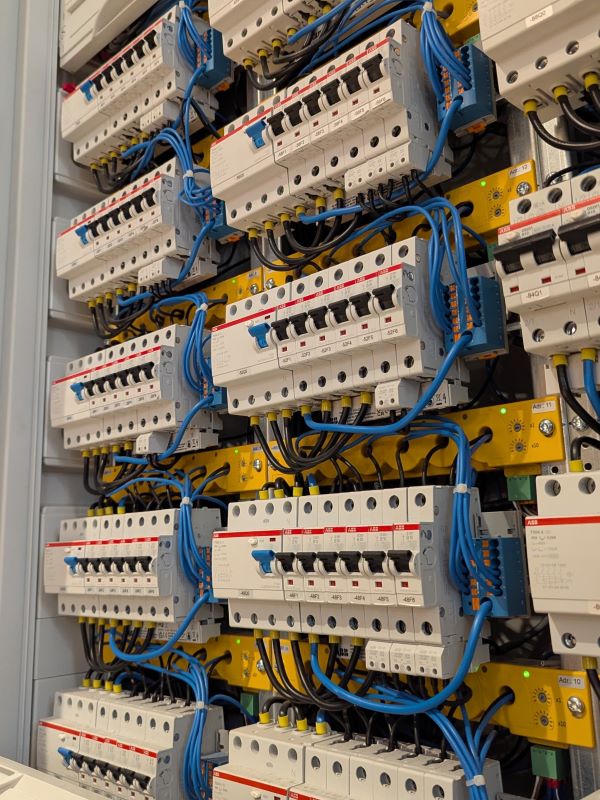
In order to achieve maximum safety and availability, permanent monitoring using residual current measurement technology was planned for each of the 96 outlets (primarily for lighting but also for the cathedral's own IT systems). This was achieved using 6-channel residual current monitoring devices of the type LINETRAXX® RCMS150, which were specially developed for use in monitoring final circuits. The devices detect even small fault currents and report any exceedance of a preset threshold value to the higher-level control technology and alarm management system. As the devices monitor final circuits, troubleshooting is greatly simplified in the event of a fault. This is because errors can be pinpointed precisely to the point of departure.
The central component of alarm management is the COMTRAXX® COM465IP Condition Monitor. This device manages all measured values and alarms from the connected monitoring devices. Furthermore, the device has a built-in web server. This means that the status of the entire electrical installation can be easily monitored via a single website. An important component of the COM465IP is its integrated alarm management system. As soon as one of the connected monitoring devices detects an increased fault current, automatically generated emails are triggered, for example to security personnel or the responsible electrician. Depending on the recipient, the emails may contain personalised text. This alarm management system ensures that faults in the electrical installation are reported immediately without the need for staff to be on site at all times.
In addition to this Condition Monitor, a COMTRAXX® CP305 signalling and control combination, normally used in hospitals, was installed in the sacristy. In the event of a fault, this device emits an audible and visual alarm and ensures that the fault can be quickly detected and rectified on site.
Finally, for testing purposes, the POWERSCOUT® monitoring software was installed on the computers of the sacristans in the sacristy and on those of the diocese's occupational safety staff. POWERSCOUT® is a long-term analysis tool that can be used to detect not only short-term but, above all, long-term changes in the condition of the electrical system.
The renovation was almost completely finished by Easter 2025. All existing lights were also replaced with energy-saving LED technology.
* Read here why granular monitoring of electrical circuits is useful.
The cathedral has been fitted with a state-of-the-art lighting system that can now be used to programme software-controlled lighting scenes. However, that is only the visible part. Under the bonnet is intelligent monitoring technology that offers maximum safety during normal operation and also in the event of a possible power failure. Thanks to continuous residual current monitoring of the individual outputs, sources of faults can now be quickly and clearly identified during operation, thereby preventing failures. The multi-stage alarm management system ensures that those responsible are informed quickly and reliably as soon as an electrical fault is detected. Permanent monitoring and alarm management also offer greater protection against electrical fires. This is a decisive advantage, especially for a listed building.
Since the renovation, the lighting system has been working perfectly. There have been no failures to date. The monitoring system also works perfectly, says Elias Witzke from AGW Elektrotechnik, which carried out the conversion and trained the sextons on site. There have also been error messages on several occasions, Elias Witzke mentions. This happens whenever rainwater enters sockets or distribution boxes in the cathedral's attic, causing a fault current. But that is precisely how residual current monitoring technology has fully fulfilled its purpose. At no time was there a dangerous situation. The cathedral is therefore very satisfied with the entire new lighting system. Above all, it is much more user-friendly than the old one.
How you avoid downtimes of electrical systems with residual current monitoring.
Advantages and benefits of residual current monitoring
The technology in brief and why there are different devices for different applications.